
Anima


Beatrice

Carl Jung believed that unconscious of man's psyche is feminine and called it Anima. The anima is a central inner figure - and it’s not just a concept, but something you experience.
Jung believed that every man carries an inner image of the feminine - formed from: his relationship with his mother, early emotional experiences with women, deeper, collective archetypal patterns (the “eternal feminine”).
It’s not literally about women - it’s about: how a man relates to feeling, intuition, eros (connection), and the soul.
The anima doesn’t sit quietly in theory - it acts through your life:
1. In relationships (projection)
You may fall in love not with the real woman, but with your inner image projected onto her. Idealization, obsession, or disappointment often signal anima dynamics
2. In emotions
Sudden moods, sensitivity, irrational feelings. Anima acts as some kind of "primitive woman"
3. In creativity and spirituality
Music, poetry, dreams, visions
The anima is often the bridge to:
imagination
intuition
inner guidance
4. In dreams and fantasies
Appears as a woman, goddess, lover, guide, witch, or mysterious figure
The anima is not a problem - it’s a gateway.
Its purpose is to guide a man toward:
emotional depth
connection to the unconscious
integration of the feminine within
If unconscious it creates chaos (projection, dependency, mood swings). If integrated it becomes a source of inner wisdom, creativity, and authentic relating.
Jung described a progression:
Eve - instinctual, biological attraction
Helen - romantic/idealized beauty
Mary (Radha) - spiritual, pure love
Sophia (Saraswati) - wisdom, inner guide
This is less about women - and more about how a man’s inner feminine matures.
Anima is basically:
The bridge from ego to soul

In Dante's "Divine Comedy" his first guide appears to be Virgil. Virgil guides Dante through Inferno and Purgatory. Virgil was the greatest poet of ancient Rome, author of the Aeneid.
Virgil here represents clear thinking, philosophy, rational understanding.
He helps Dante make sense of chaos - but only up to a point.
He is calm, composed, and grounded when Dante is afraid, overwhelmed and lost.
In Jungian terms, he’s like the inner masculine guide (logos) that helps navigate the unconscious.
But Virgil can not enter the Paradise.
Virgil stops at the gates of Heaven because reason alone cannot reach divine truth. Something else is needed: faith, love, grace. At that point, Dante is guided by Beatrice, who represents divine love, spiritual illumination, the higher feminine principle.
So Virgil is the necessary guide - but not the final one.
The journey goes like this:
Virgil (reason) - helps you face shadow, chaos, and truth
Beatrice (love/divine feminine) - leads you to transcendence
Without Virgil it is chaos. Without Beatrice it is dryness without soul.
Together - wholeness
The story goes that Dante saw Beatrice on the Bridge of Ponte Vecchio in Florence. Just a moment of seeing her, he describes it as a spiritual awakening - almost like encountering something divine. They spoke only once and later Beatrice died and Dante have married another women, but that experience was sacred to him.
When we project anima on someone we project our own inner divinity on another person, and almost always it has nothing to do with the person itself. It is the image of God we see, yet activated by another person. For some people this is the only experience of the divine they have, the only moment God can catch them.
When the American army advanced on German army in Italy during WWII, German blowed up all the bridges when they retreated so the Americans can not use them for their advantage. But nobody wanted to blow up the Ponte Vecchio, because the Beatrice stood there. So the Germans made the radio contact with Americans and made the agreement that they will not destroy the Ponte Vecchio if Americans will not use it. The agreement was fulfilled, the bridge was saved, and not a single American solder stepped on it. If you need any concrete proof of anima, I think this is the one.
Next story demonstrates how man have lost his anima.
The Girl Who Last His Hands

A miller had fallen by degrees into great poverty until he had nothing left but his mill and a large apple tree. One day, when was going into the forest to cut wood, an old man, whom he had never seen before, stepped up to him and said, "Why do you trouble yourself with chopping wood? I will make you rich if you will promise me what stands behind your mill." The miller thought to himself that it could be nothing but his apple tree, so he said yes and concluded the bargain. The other, however, laughed derisively and said,
"After three years I will come and fetch what belongs to me.
As soon as the miller got home, his wife asked him the origin of the sudden flow of gold that was coming to the house. The miller told her that it came from a man he had met in the forest, to whom in return he had promised what stands behind the mill. "For," said the miller, "we can very well spare the great apple tree."
"Ah, my husband," exclaimed his wife, "it is the Evil Spirit whom you have seen. He did not mean the apple tree, but our daughter, who was behind the mill sweeping the yard." The miller's daughter was a beautiful and pious maiden, and during all the three years lived in the fear of God. When the day came for the Evil One to fetch her, she washed herself quite clean and made a circle around herself with chalk, so that he could not approach her. In a rage he said to the miller, "Take her away from all water, that she may not be able to wash herself; else have I no power over her." The miller did so, for he was afraid. But the next morning, when the Evil One came, the girl had wept upon her hands, so that they were quite clean. He was baffled again and in his anger said to the miller, "Cut off both her hands, or else I cannot now obtain her."
The miller was horrified and said,
"How can I cut off the hands of my own child?"
But the Evil One pressed him, saying,
"If you do not, you are mine, and I will take you yourself away!"
The miller told his daughter what the Evil One said and asked her to help him in his trouble and to forgive him for the wickedness he was about to do her. She replied, "Dear father, do with me what you will—I am your daughter." And her father cut her hands off.
For the third time now the Evil One came. But the maiden had let fall so many tears upon her arms that they were both quite clean. So he was obliged to give her up and after this lost all power over her.
The miller now said to her, "I have received so much good through you, my daughter, that I will care for you most dearly all your life long."
But she answered, "Here I cannot remain. I will wander forth into the world, where compassionate men will give me as much as I require."
The Continuation of the story
Then she had her arms bound behind her back and at sunrise departed on her journey. In time she arrived at a royal garden, and by the light of the moon she saw a tree which bore most beautiful fruits. She could not enter the garden, for there was water all around, but she was tormented by hunger, so she kneeled and prayed to God. All at once an angel came down, who made a passage through the water, so that the ground was dry for her to pass over. So she went into the garden, but the pears were all numbered. She stepped up and ate one to appease her hunger, but no more. The gardener perceived her do it, but because the angel stood by he was afraid, and thought the maiden was a spirit.
The next morning the king found that a pear was missing and asked the gardener whither it was gone. He replied, "Last night a spirit came, who had no hands, and ate the pear with her mouth."
The king then asked, "How did the spirit come through the water? And whither did she go after she had eaten the pear?" The gardener answered, "One clothed in snow-white garments came down from heaven and made a passage through the waters, so that the spirit walked over on dry land. And because it must have been an angel, I was afraid, and neither called out nor questioned it; and as soon as the spirit had finished the fruit, she returned as she came."
The king said, "If it be as you say, I will this night watch with you."
As soon as it was dark, the king came into the garden, bringing with him a priest. At about midnight the maiden crept out from under the bushes and again ate with her mouth a pear off the tree, whilst the angel clothed in white stood by her.
Then the priest went toward her and said, "Art thou come from God or from earth? Art thou a spirit or a human being?"
She replied, "I am no spirit, but a poor maiden, deserted by all, save God alone."
The king said, "If you are forsaken by all the world, yet will Inot forsake you," and he took her with him to his royal palace.
Because she was so beautiful and pious, he loved her with all his heart, ordered silver hands to be made for her, and made her his bride.
After a year had passed, the king was obliged to go to war and left the young queen to the care of his mother. Soon afterward a boy was born, and the old mother wrote a letter to her son containing the joyful news. But the messenger rested and fell asleep on his way, and the Evil One changed the letter for another saying that the queen had brought a changeling into the world. As soon as the king had read this letter, he was frightened and much troubled, but he wrote to his mother that she should take great care of the queen until his arrival. But the messenger again fell asleep on the way and the Evil One put a letter in his pocket saying that the queen and her child should be killed. When the old mother received this letter, she was struck with horror and wrote another letter to the king, but received no answer. Rather, the Evil One placed another false letter for the mother into the messenger's pocket, saying that the mother should preserve the tongue and eyes of the queen as a sign that she had fulfilled the order.
The old mother was sorely grieved to shed innocent blood, so she cut out the tongue and eyes of a calf and said to the queen,
"I cannot let you be killed as the king commands, but you must remain here no longer. Go forth with your child into the wide world and never return here again."
Thus saying, she bound the child upon the young queen's back, and the poor wife went away, weeping bitterly. Soon she entered a large forest, and there she fell upon her knees and prayed to God. The angel appeared and led her to a little cottage, over the door of which was a shield inscribed with the words: "Here may everyone live freely."
Out of the house came a snow-white maiden who said,
"Welcome, Lady Queen," and led her in and said she was an angel sent from God to tend her and her child. In this cottage the queen lived for seven years and was well cared for; through God's mercy to her, on account of her piety, her hands grew again as before.
Meanwhile the king had come home again, and his first thought was to see his wife and child. Then his mother began to weep and said, "You wicked husband, why did you write me that I should put to death two innocent souls?" And showing him the two letters which the Evil One had forged, she contin-ued, "I have done as you commanded," and she brought him the tokens— the two eyes and the tongue.
The king then began to weep so bitterly for his dear wife and son that the old mother pitied him, and said, "Be comforted, she lives yet! I caused a calf to be slain, from whom I took these tokens; but the child I bound upon your wife's back, and I bade them go forth into the wide world, and she promised never to return here because you were so wrathful against her."
"So far as heaven is blue," exclaimed the king, "I will go; and neither will I eat nor drink until I have found again my dear wife and child— if they have not perished of hunger by this time."
Thereupon the king set out, and for seven long years sought his wife in every stony cleft and rocky cave, but found her not and began to think she must have perished.
But God sustained him, and at last he came to the large forest and little cottage. Out of the house came the white maiden, and leading him in, she said, "Be welcome, great king! Whence comest thou?"
He replied, "For seven long years have I sought everywhere for my wife and child, but I have not succeeded."
Then the angel offered him food and drink, but he refused them both and lay down to sleep, and covered his face with a napkin.
Now went the angel into the chamber where sat the queen, with her son, whom she usually called "Sorrowful," and said to "Come down with your child. Your husband is here." So she went to where he lay, and the napkin fell from off his face.
So the queen said: "Sorrowful, pick up the napkin, and cover again your father's face." The child did as he was bidden, and the king, who heard in his slumber what passed, let the napkin again fall from his face.
At this the boy became impatient and said, "Dear mother, how can I cover my father's face? Have I indeed a father on the earth? I have learned the prayer, 'Our Father which art in heaven'; and you have told me my father was in heaven-the Fatd God. How can I talk to this wild man? He is not my father.
As the king heard this, he raised himself up and asked the queen who she was. The queen replied, "I am your wife, and this your son, Sorrowful."
But when he saw her human hands, he said, "My wife had silver hands."
"The merciful God," said the queen, "has caused my hands to grow again"; and the angel, going into her chamber, brought out the silver hands and showed them to him.
Now he perceived that they were certainly his dear wife and child and kissed them gladly, saying, "A heavy stone is taken from my heart." After eating a meal together with the angel, they went home to the king's mother.
Their arrival caused great rejoicings everywhere; and the king and queen celebrated their marriage again and lived happily together until the end of their lives.
I have found this story in the book of Marie-Louise von Franz " The Feminine in Fairy Tales'
It is common believe that figures in the myth are the stories of gods and the fairy tales aer the stories of ordinary people. However, in some fairy tales names point to gods. For example, in "Sleeping Beauty" in many versions the children are called Sun and Moon.
So the mother of the Sun and the Moon is not an ordinary human being, so you could say it it a symbol. So if characters have names such as Sun, Moon, Day or Dawn that means that we are entering in the realm of gods, we know from psychological perspective that they are archetypal figures. For this reason there is not difference between myth and fairy-tale.
Religion on other-hand is the structured and polished myth. Take Christianity for example. There is no adequate metaphysical representation of feminine. Women does not have representation in Upper Parliament as Jung have said. For this reason women in western world have disorientation and uncertainty about their identity. But this suppression of the feminine in our religion has a lot to say about men as well.
The God is a man, his son and savior also man and his prophets are also men. Women are not allowed to be priestess in our religion. This anxiety towards feminine is traced in monotheistic religions such as Christianity and Islam which is discussed in more details here. This anxiety in my opinion is due to men cannot succesfuly cope with their mother's complex and thus integrate the feminine.
This repression of the feminine has the tremendous effect on our civilisation and the Earth.
Marie-Louise von Franz says that Protestantism must accept the blame of being purely men's religion in the West. Catholicism has at least the Virgin Mary as an archetypal representation of femininity. But even she is only a holy vessel for God, untouched by mortal men, but not a Goddess. Also this feminine archetypal image is incomplete because it encompases only the sublime and light aspects of the divine feminine principle and therefore does not express the whole feminine principle.
Therefore, it is very useful for us studying ancient religions and philosophies, such as Hindu, where Goddess was never excluded. She is dark-mother Kali, powerful Durga, abundant Lakshmi, and Wisdom Saraswati. India by the way has the unbreakable history of civilisation of more than 6000 years, that's why it makes it so special.
In Hinduism the male forms of the divine owed their divinity to their female counterparts. This why they addressed as husbands of the Goddess. Shiva is Uma-pati ( husband of Uma), and Vishnu is Lakshmi-vallabha (beloved of Lakshmi). Male gods can be addressed only after the name of the consort is mentioned. Thus, Shiva is Uma-Mahesh and Vishnu is Lakshmi-Narayana. Devi here is not a supplement; she is complement.
What is also interesting for studying the archetypal material is fairy-tales. If the religion has purposely structured myth, the collective unconscious find it's that into this tales and outpurred there. Fairy-tales express the creative fantasies of the rural and less educated layers of population. They have the great advantage of being naive ("not literary") and of having been worked out in collective groups, with the result that they contain purely archetypal material unobscured by personal problems.
The fairy tale "The Girl Who Last His Hands" has a lot to do with woman development, but it can also be read from male perspective.
The theme of the miller is very ambivalent in folklore. Looked at from a naive angle, the peasan't angle, he is the only peasant who does not do any hard work, a primitive kind of Mercurius who has the trick of making water work for him. There are many stories how the miller exploits the hardworking peasants in the neighbourhood by putting up the price of flour. Thus he carries a projection of being the working devil and a power fiend.
On the other side, the invention of the water mill is a very ingenious one, both creative and clever, and the wheel is a mandala.
So the miller is also a constructive figure, a Hermes-Mercurius, and belongs in that mythological family. In folklore, the benevolent miller-who stores the flour in times of plenty and gives out from the reserves in times of scarcity often appears, and is then the benefactor of the country. So he can be said to have the mercurial quality of human consciousness, which can be used for good or evil. Here he has come to the end of his tether and therefore sells something to the devil; you could say that the devilish quality is very close. Though he acts half innocently, in a moment of difficulty he lets something within his realm fall into the devil's hands. This would refer to the misuse of intellectual consciousness for an unethical goal, which naturally is something which every intelligent person is tempted to do in a moment of difficulty.
The problem in our story is constellated in its nucleus, the abuse of getting oneself out of difficulty by a conscious trick. What we now lose on the scale is our own soul, we are doing the same thing as the miller, thinking that we are just sacrificing a bit of nature.
During the course of industrial we have killed almost all the whales, and because of that we are risking to deprive ourselves of very oxygen we breath. Oil & Gas exploration has brought up the global warming. We filled all the oceans with microplastic. But still it is not enough, and now AI is also competing with us for resources.
However, the impact is not only ecological. We do not suffiecently realsie our own carelessness in regard to nature and are selling our souls to the devil, whereby certain psychological values are lost. Yes, we have lights, screens, even AI, but more and more we are disconnected of reality - the walking in the dark rainy night, or the beauty of moonlight landscape - the ever changing aspect of nature in its natural surroundings.
So from the miller's his daugher would represent him anima figure - that is, a part pf his feeling and emotional life which is now sold to evil and falls into devil's hands. If we take it from the feminine standpoint, one could say that this represents the case of a woman who through a negative constellation of her father complex has fallen into the greatest danger.
What would it mean if the father sells his own daugter to the devil, because he is at the end of his resourses ? If a miller gets into such difficulties, it is a result of a general collective catastrophe where, with a thorougly asocial attitude, he wants to save his own skin at the expense of others; or if his difficulty is individual, then something must be working at his mill. Otherwise why should he be at difficulty ? In such a case, he should ask himslef why his mill and his business are in such a bad way. What laws of life has he igonered?
In similar storires the miller is replaced by the figure of an old king who got stuck. This refers to the widespread motif of the king's need for renewal. He represents the central principle of collective consciousness which wears out periodically. In our story the father is not a king but a rich merchant, so he would more likely represent the commercial outlook of collectivity which has exhausted itslef. All intellectual qualities of the human mind have the quality of wearing off after a certain time. One aspect of consciousness has been used too lomg and became routine, and then it becomes meaningless.
Instead of facing poverty and discovering something new, he wants to continue the old way.
Ravana

The same story of the downfall can be traced in Hindu epic Ramayana.
Ravana is often reduced to “the villain” of the Ramayana, but in the deeper Indian tradition he is a highly sophisticated, multidimensional character - in fact, he was Shiva's greatest devotee.
So who was Ravana actually ? Born to Vishrava, a revered Brahmin sage. Grandson of Pulastya (one of the great rishis). This makes Ravana a Brahmin, not a demon in origin
Ravana was a scholar, master of the Vedas and master-musician. Deeply learned in Ayurveda, astrology, and philosophy. Credited (in some traditions) with texts like Ravana Samhita (astrology), medical and tantric knowledge system. He wasn’t ignorant - he was overdeveloped intellectually.
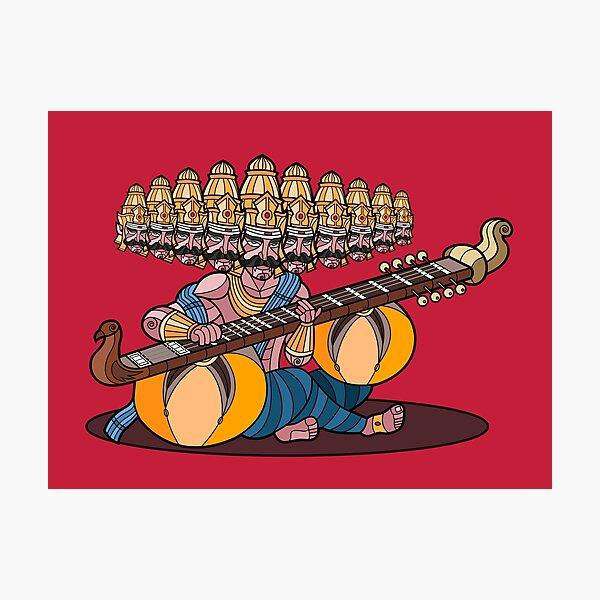
Ravana is associated with mastery of the Veena. Sometimes credited with inventing the Rudra Veena. He composed the powerful hymn Shiva Tandava Stotram. It celebrates Lord Shiva through vivid, rhythmic verses that describe his cosmic dance - the Tandava - a symbol of the universal cycle of creation, preservation, and destruction. His music wasn’t mere entertainment - it was devotional, ecstatic, cosmic.
So this one of the most important aspects, he was fierce devotee of Shiva. Puranas describe him performing extreme austerities (tapas), offering even his own heads in devotion and then receiving boons from Shiva due to his intensity. This makes him a true yogi in discipline - but not in humility.
As ruler of Lanka, Ravana built a golden, highly advanced kingdom, was an excellent administrator and strategist. In some readings, Lanka represents a perfected material world, but something was missing... And Ravana decides to abduct Sita.
Sita is the anima mundi - soul embedded in life. Inner eros, meaning, devotion, fertility. Vulnerable to abduction when consciousness is distracted. Her abduction symbolizes the moment a man loses contact with his inner feminine, life becomes dry, anxious, or mechanical.

Ravana is not “evil” psychologically - he is inflated intellect, power without heart, masculinity cut off from anima. In Jungian terms Ravana abducts the anima and turns her into an object - not a partner. He wants to dominate his feminine by force. It is not wholeness, but Logos dominating Eros.
Rama represents the ordered masculine consciousness. Ethical, disciplined, but initially incomplete. Capable of rule and clarity - yet cut off from inner feeling. Before losing Sita, Rama is functional but not whole.
To find Sita and rescue Sita he has to unite with his instinctive nature - Hanuman. Without instinct on your side, the anima cannot be found.
This is not a war for Sita, but a war with oneself.
Conscious ego (Rama) vs Shadow intelligence (Ravana). Allies = integrated instincts and values. Victory means Ego no longer ruled by shadow inflation.

Sita’s Fire Ordeal is one of the most misunderstood moments. Fire it is discernment. Sita passes untouched because she is inner truth, not possession. Rama must learn: the anima cannot be owned -only honored. True integration ≠ control.
A man cannot rule the world if he has not reconciled with his inner feminine. Losing the anima leads to exile, anxiety, and violence. Finding her requires humility, devotion, and patience. Integration does not mean fusion - but conscious relationship. Rama becomes king only after the anima is restored - not before.
Vishnu Go-pala

In the Puranas, Bhu-devi ( Earth - Goddess) is often visualised as a cow. The story goes that a king called Vena plundered the earth so much that rishis had to intervene and kills this greedy king. They churned his corpse and from the purified remains created a new king, Prithu. Prithu was a form of Vishnu. He discovered that the earth had run away in the form of a cow so he pursued her with his bow and arrow, threatening to strike her if she did not stop and allow his subjects to milk her. "If you kill me, the world will cease to exist", she cried. "But if you cannot be milked, the world cannot survive", argued Prithu. So finally, assured that he would protect her and not anyone plunder her, Bhu-devi let herself be milked by all living creatures under watchful eye of Prithu.
As Prithu, Vishnu declared that the kings of the earth would be guardinas of Bhu-devi, and he himself would descend on earth if she was troubled. He becomes the Go-pala, or caretaker of the earth-cow Go-mata.
Our attitude in repression of the feminine, the Goddess creates a certain attitude toward the nature and our planet Earth.
Modern industry is built on a simple assumption:
Nature is passive.
Humans are active.
We design systems to extract, optimize, accelerate. We measure success in efficiency, output, and scale.
But this worldview creates a dangerous illusion - that the nature is inert, waiting to be acted upon.
All our industry is based on extraction, storing, and discarding. By extraction and our greed to store more than we need, we disrupt the ecosystems which formed millions of years.
Abundance can not be created by extraction and storing, because we compete for resources and destroy everything eventually.
Nature creates abundance for all and we can learn from her. Rich is not the one who has much, but the one who can give much. That is why abundance is not created by storage, but circulation and flow.
Imagine an isolated industrial activity, but a layers within an ecosystems.
Nature does not lecture. It demonstrates. In natural systems, waste does not exist. Outputs become inputs. Energy flows, nutrients cycle, systems regenerate.
We must shift how we see the nature:
Not as a resource, but as relationship.
Not as space, but as process.
Not as object, but as intelligence.
I believe this is the highest ideal for men to serve the Goddess. Taking care of someone shows one's true potency, and usurping and dominating showing only one's fear and anxiety toward life.
Stewardship of the Earth


The idea of the Stewardship of the Earth, has long been dominant in the Native Americans thinking. This art-piece was saw at our dentist office in Victoria, BC. And as it is a traditional art, we can assume that artist depicted everything which is most important here.
Men have created industrial system by dreaming of the future, where he is able to satisfy all his material needs. This is accomplished, but by dreaming of conquering nature the man himself became the slave of the system he created,
such as capital and market.
Nature providing us with everything we need, but isn't it an illusion that we are able to exist without the nature ?
It isn't about to stop innovating, but innovating differently.
To listen before we design. To observe before we act.To participate rather than dominate.
Because the most advanced system on this planet is not artificial.
It is already here.
Flowing, adapting, evolving - an intelligence without a center,a system without a master,a rhythm we have yet to fully understand.
It suggests that the next wave of innovation will not come from more control, more speed, more extraction.
It will come from alignment.
We think that animals are only primitive form of life. But ancient shamans as well as yogis understood that every living being is a teacher.
Who will taught us about our instincts ? Whom will we see in our dreams if all the animals cease to exist?
No longer have we a share in the emotional experiences of our ancestors, which have been a part of man since he first came into being: the full moon, the whistling of the wind in trees, link us to instinct and the life of the unconscious past. There is a whole scale of emotion which enriches our lives and links us with our ancestry.
Not only the destroy the apple tree, but those experiences which belong in the whole pattern of nature.
The shift of attitude which is required it is not mere intellectual, but relational. It is not possible that would be treat the Earth as a partner, until we are disconnected with our own bodies, feelings, our soul.
“The Eternal Feminine draws us onward.” - Goethe
Nikita Ierisov,
Philosopher, Jyotish Astrologer


Comments