
Architecture is a Frozen Music

Updated: Jan 29
Pythagors is widely known for his mathematical genius, but he is also called a GodFather of Sound Medicine in the West.
As legend goes, he was the first one to create a musical scale in the West.

He made experiments with his monochord or lyre according to one legend.
He noticed that if he shortened the string twice = the frequency is doubled. But it was the same note, but the octave higher. This was the discovery of the first interval in music.
Later, the other intervals were discovered which could also be expressed as simple whole-number ratios.
Pythagoras noticed that combining this intervals creates harmony between notes - the notes which follow ratios of integers are consonant and other which could not be expressed as ratio of whole-numbers are dissonant.
If we divide a string into twelve equal parts and shorten the string to the points 6,8 and 9 ( thus obtaining the proportions 12:6 = 2:1, 12:8 = 3:2, 12:9 = 4:3), then by shortening the string by one-half we get the octave; by two-thirds, the fifth, by three-fourths, the fourth and so on.

European Architecture
Throughout history, many sacred buildings have been designed as "frozen music" - embodying the same harmonic ratios that govern musical intervals. Ancient architects saw temples not just as physical spaces, but as vibrational instruments, tuned to align the human body, the cosmos, and the divine.
Pythagoras (6th century BCE) discovered that musical harmony arises from simple numerical ratios:
Octave = 2:1
Perfect Fifth = 3:2
Perfect Fourth = 4:3
Major Third = 5:4
Minor Third = 6:5
Minor Sixth = 5:8
These ratios were seen as universal laws connecting sound, geometry, and spirit.
Pythagoreans believed:
“A temple must be built according to the same laws that govern a lyre or a harp.”
This idea inspired later architectural traditions - particularly in Greece, Rome, and Gothic Europe.

The Parthenon in Athens is one of the clearest examples, where width : length ≈ 9:4 → close to two perfect fourths (4:3) stacked and height : width ratios approach octaves (2:1) and fifths (3:2). Columns were spaced like notes in a scale, creating a rhythmic visual "melody."
Greek architects believed this harmony invited Apollo (god of music and light) to dwell in the temple.

Gothic cathedrals are some of the most literal expressions of "frozen music": the height of the nave to width of the transept often equals a perfect fifth (3:2), rose windows are designed with proportions of octaves and fourths, mirroring sacred scales so the entire cathedral acted as a giant resonator for Gregorian chant.
Where The nave is the main central hall of the cathedral - the long, tall space where people walk and where the congregation gathers. And the transept is the cross-arm of the cathedral.
A rose window is a large circular stained-glass window, usually placed in the transept or the west facade.

They are called “roses” because:
the circular geometry resembles a flower
the radial symmetry mirrors petals
the proportions often follow sacred musical intervals (octaves, fourths, fifths)
They were designed to glow with colored light and act like visual mandalas.
When choirs sing in Chartres Cathedral which is in France, the building’s geometry amplified overtones, making chants seem otherworldly.
Vedic Architecture
The sonic architecture of Vedic temples is incredibly rich.
In Vedic tradition, temples were designed as yantras - geometrical forms that amplify sound and consciousness. The central garbhagriha (sanctum) represents the "drone" or root note (like a tanpura's fundamental tone) and outer mandapas (halls) expand in ratios similar to a harmonic overtone series. Sri Yantra, found in many temples, is constructed from intersecting triangles based on musical intervals, especially 3:2 (perfect fifth) and 4:3 (perfect fourth).
1. Chidambaram Nataraja Temple (Tamil Nadu) - the “Cosmic Dance Frequency”

Chidambaram is one of the strongest examples of a temple built explicitly as a sonic yantra.
The temple proportions follow the Agamic “Tala–Mana” system, which is literally based on tala, rhythm.

The Kanaka Sabha (Golden Hall) is tuned to the 5-beat cycle associated with Shiva’s Nritya (dance).
The sanctum (garbhagriha) height:width ratios follow the 3:2 perfect fifth - considered the most stable harmonic interval.
The empty space inside the sanctum (Chidambara Rahasya) represents the akashic “drone”, the primordial OM.
Brihadeeswarar Temple (Thanjavur, Tamil Nadu) - Great Living Chola Temple.

In Brihadeeswarar Temple in Tamil Nadu proportions follow the ratios of the Sama Veda chants sung inside it, the tower resonates with mantras, turning the entire temple into a living instrument.
Brihadeeswarar Temple is a 1,000-year-old Shiva temple built during the Chola Empire (1010 CE) by King Rajaraja Chola I.
UNESCO calls it a “Great Living Chola Temple”
because rituals continue today exactly as they did a millennium ago.

The Sama Veda is the “musical” Veda - originally sung, not spoken.Its chants use precise musical intervals:
1:1 (unison)
2:1 (octave)
3:2 (perfect fifth)
4:3 (perfect fourth)
The temple’s layout: garbhagriha : mandapas : tower follows these same ratios.
Sanctum height : width = 3:2
Vimana height expansion = 4:3 stepped ratios
Mandapa spacing = 1:2 octave doubling
This creates a structure that behaves like a giant resonant chamber.
The Cholas selected granite specifically because it carries sound vibrations extremely well.
The temple is a massive granite construction with 66-meters-tall vimana (tower), built without mortar (paste used in construction to bind stones or bricks together).
Inside the temple: low-frequency OM chants vibrate through the sanctum, the tall vimana acts like an acoustic amplifier and the stones absorbs overtones, causing a drone-like hum.
Many acousticians describe Brihadeeswarar as:
“A stone tanpura.”
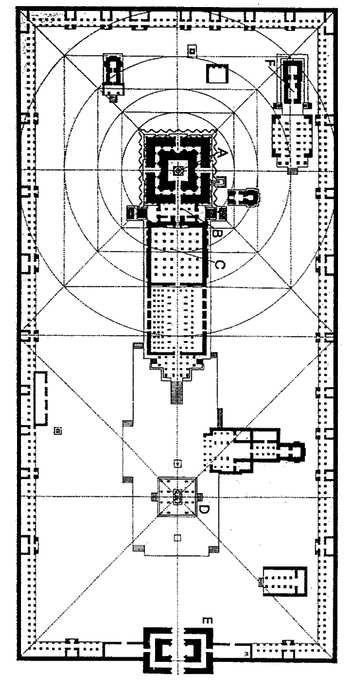
The entire layout follows Vastu + Agama mathematical rules that link architecture to sound and consciousness, which is:
mandala geometry
Vastu Purusha Mandala (energy grid)
Sama Veda scale intervals
Sri Yantra-like proportional expansions
In Vedic understanding:
A temple is not a building you pray in. It’s a geometry you enter so the space can tune you.
3. Meenakshi Temple (Madurai) - Mandapa “Raga Geometry”

A mandapa (मंडप) is a hall with pillars, usually built in front of or around the temple’s inner
sanctum (garbhagriha).
Mandapas here are arranged in expanding square yantras based on the Sarvatobhadra grid (4×4, 8×8, 16×16).
This reflects: the doubling principle of octaves (1:2, 2:4, 4:8) and a yantra-like expansion from the “root tone” (garbhagriha)
Interestingly, the 1,000-pillared hall is built so that claps generate coherent echoes, like a natural reverb chamber.

4. Sun Temple, Konark - Musical Instrument of Stone
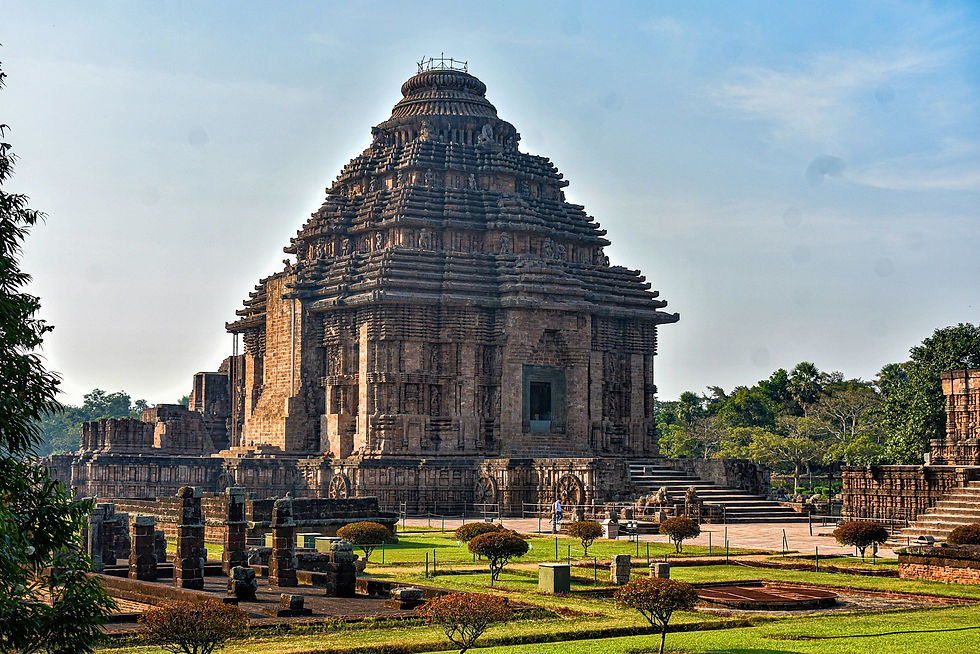
Konark is known for the “melody stones”: When struck, different stone slabs produce
distinct tones. Archaeologists have measured intervals close to major thirds and fourths.
The temple itself is built as a giant chariot, whose wheel spoke ratios follow:
3:2 (perfect fifth)
8:6 (fourth)
6:4 (fifth again)
This is also consistent with Sri Yantra geometry.
5. Sri Yantra Itself - Pure Musical Diagram

The Sri Yantra is built on:
1:√2 diagonal (like a perfect fourth equivalence)
3:2 triangle intersection ratios
7 concentric “avaranas” that function like harmonic layers in Indian classical music
Temples like Sringeri Sharada Peetham and Devipuram use the Sri Chakra as the architectural ground plan.

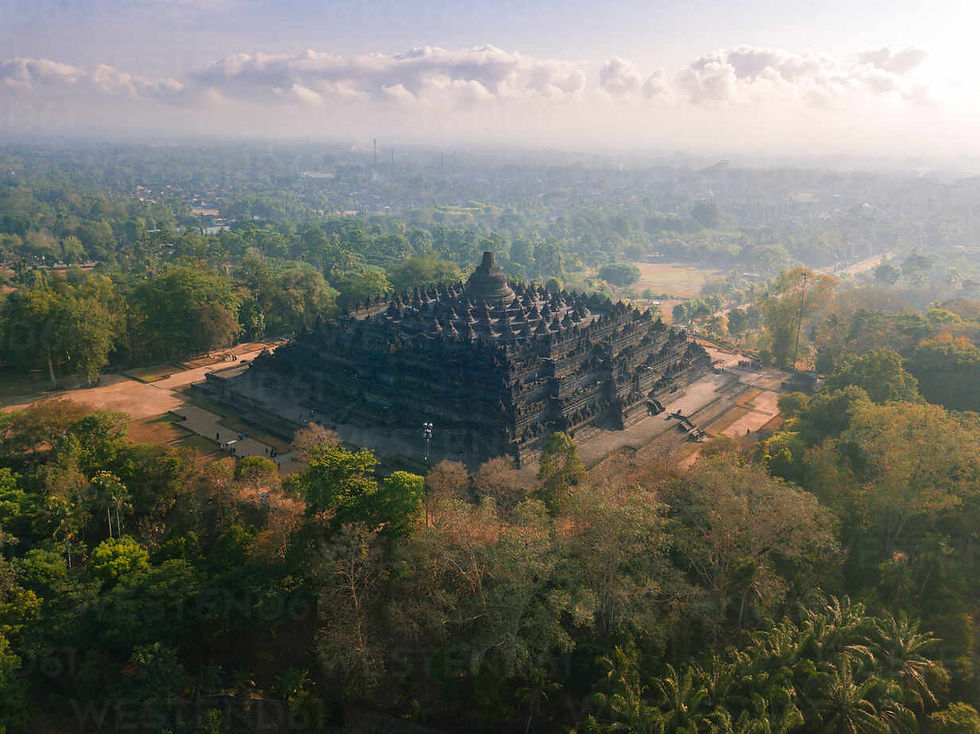
Borobudur is a 9th-century Mahayana Buddhist temple in Central Java, Indonesia.
Built by the Sailendra dynasty, it is the largest Buddhist temple in the world.
What makes it extraordinary is that it is not a temple you enter.I t’s a diagram you walk, a sacred mountain, and a 3D mandala carved in stone.
Many scholars, yogis, and tantra practitioners note that Borobudur’s structure aligns closely with the Sri Chakra Meru - a three-dimensional Sri Yantra.
6. Vitthala Temple, Hampi - the “Stone Musical Mandapa”
One of the most literal sonic structures in the world.
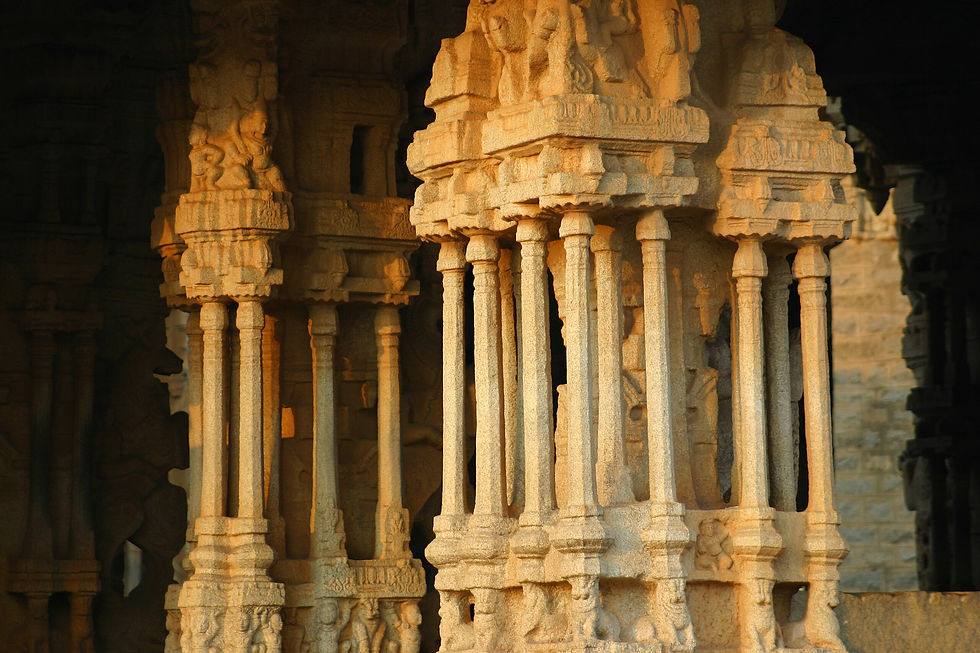
The 56 “musical pillars”
When tapped, they produce classical Indian notes:
Sa
Ri
Ga
Ma
Pa
Dha
Ni (overtones of the fundamental tone)
The geometry of the mandapa is arranged in octave expansions from the garbhagriha outward.
7. Jagannath Temple, Puri - axis tuned like a tanpura
The central axis of four spaces:
garbhagriha
antarala
nata-mandira
bhoga-mandapa
is proportioned like the four strings of a tanpura → fundamental + 5th + octave + 5th.
“Architecture is frozen music.” - Goethe
Stay tuned for updates !
(c) Nikita Ierisov - Philosopher, Jyotish Astrologer
Keeper of Dharma Station
Yoga and Sound Retreat on Vancouver Island

Comments