
Flow of Life - Flow of Possibilities


Can we consider a life as a Flow ?
Why is it that we can neither drift passively nor resist it?
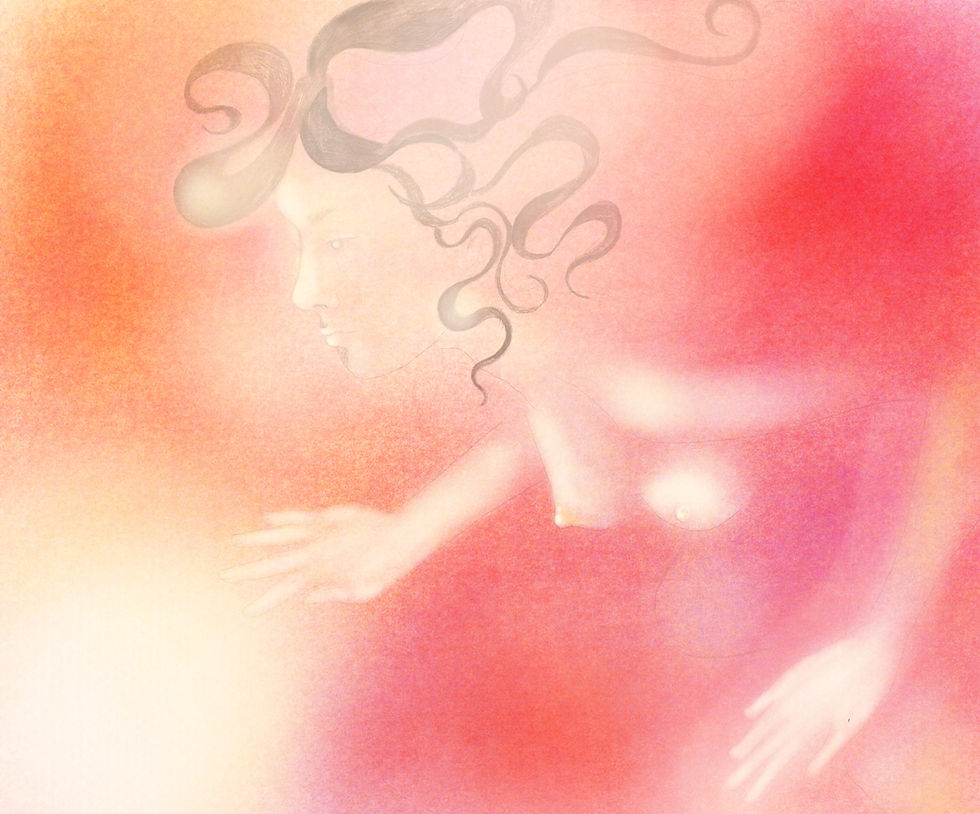
In Vedic cosmogony - personification of flow is goddess Saraswati - “Saraswati” comes from "saras" (flow) and "wati" (she who has), symbolizing the flowing stream of Wisdom. She's often depicted as a serene, beautiful woman dressed in white, symbolizing purity and transcendence of materialism. Her Vahana (Vehicle) is a swan (hamsa), symbolizing wisdom.
Veena (Musical Instrument): represents her mastery over arts and music. Also Veena is another hint into that reality is vibrational. The nature of the sound of the veena is very soft and warm, it has long long resonance and highly expressive microtones. When played very gently, the sound can become extremely subtle, because of this, the veena was often played in in intimate settings or temples, not large concert halls. But another nuance is that the player hears the vibration through the body of the instrument, which rests against their body. The musician also feels the vibration through the hands and chest, making the experience more internal. So the player perceives more detail and resonance than listeners further away. Because of this nature of the veena, it also hints us to the connection with meditation, thus symbolising internal Wisdom, coming from within.
Take a note that she is a goddess of Wisdom and Art - thus together symbolising the Flow.
This hints us that we can learn how to enter into the state of flow through practice of art.
It also hints us that Wisdom is not mere intellect, but something else.
True Wisdom is achieved within the state of flow with life.
Saraswati is also sometimes referred as divine consort of Brahma - a creator God.
In Christianity we can find that Sophia (Wisdom) served as an artist to God and helped him to create the world.
In Egypt, we know Isis. In Egyptian thought she is not only a goddess, but the one who knows - the keeper of names, spells, rhythms, and the hidden laws that bind heaven and earth. She outwits Set and even sun-god Ra himself.
No matter how earnestly one tries, the mind rarely arrives at the optimal course of action through logic alone. More often than not, it is clouded - burdened by the weight of worry, the fog of depression, or the noise of excessive activity. In truth, the mind is perpetually swayed by external pendulums, those unseen forces that tug at its attention and distort its clarity. Thus, rather than moving with grace or wisdom, it charges forward - forceful, reactive, attempting to overpower reality through sheer will.
What is a Wisdom then ?
"The Swan of Wisdom Has Two Wings: Knowledge and Action" — Yoga Vasistha
In this profound Vedantic scripture, where the sage Vasistha guides the young prince Rama, we find a powerful metaphor: True wisdom must be supported by both wings - knowledge (jnana) and action (karma).
The Yoga Vasistha teaches that:
If one only knows, but does not act, then knowledge remains a dry mental concept.
If one only acts, without understanding, the actions become blind and ego-driven.
“Just as a bird cannot fly with one wing, wisdom cannot soar without the union of knowledge and action.”
In medieval times, as Devadutt Patanaik says in the "7 Secrets of the Goddess" it was common to show Lakshmi and Saraswati as the two consorts of Vishnu, and Shakti as his sister. The rival sect of Shiva-worshippers also appropriated Lakshmi and Saraswati by placing them on either side of Ganesha, Shiva's more worldly son. In Bengal, Lakshmi is associated with the food-loving Ganesha, who is associated with learned Brahmins; and Saraswati with art-loving Kartikeya, associated with affluent landowners.
Despite being linked to Brahma, Vishnu and Kartikeya, images of Saraswati with a male consort are rare. She is known as aloof and distant, always alone, content in her own company, an indicator of true wisdom.
Origin of Saraswati can be traced to six thousand years old Rig-Veda. There she shares her name with the river Saraswati flowing from the mountains (Himalayas) to the sea and her qualities with Vak, goddess of speach, language and meaning.
The Vedas paid great attention to language. Language was at one time called "brahman", which etymologically means that which expands (√bṛh, Sanskirt) manas - mind.
Language emerges from imagination and it also expands imagination. Imagination is fluid (saras), and can either be contained as a lake (sarovar) or made to flow like a river (sarita). From saras, comes Saraswati. She is even called Veda-mata, the mother of the Vedas. She is also the mother of svaras (musical notes) and ragas(scales).

All creativity born from inspiration and illumination has nothing to do with the rational mind.The mind only later claims the products of such creativity as its own attributes.The mind can perfectly replicate an old masterpiece - but it cannot create a new one.It merely analyzes data received by the subconscious from the field of information(akasha),and then wraps it in a symbolic interpretation. Likewise, fundamental scientific discoveries do not arise from logical reasoning, but come as sudden insights - as if knowledge appears out of nowhere.Interesting, that the most prominent and renovated scientist of our time - Albert Einstein had his Mercury (Buddhi), which in astrology is responsible for rational mind, calculation and logic - debilitated (meaning very weak).
"I never came upon any of my discoveries through the process of rational thinking." - Albert Einstein
As a young boy, he imagined himself riding on a beam of light, gliding through the infinite fabric of space.
"What would I see, if I could move alongside a ray of light?"

This simple yet profound question sparked the seed of the Theory of Relativity - one of the most groundbreaking shifts in our understanding of space and time.
Information reaches our consciousness in two ways: either from the external world - as an interpretation of sensory data, or from the subconscious - on an intuitive level.
The data stored in the info-field can be seen as truth in its pure form -in other words, objective information, free from interpretation. The Greek philosopher Plato called this data Eidos.
Yet when truth passes through the filter of the rational mind, it transforms into interpretation - it becomes knowledge.
All living beings perceive truth through their own interpretive lens.Therefore, knowledge is always a more or less distorted reflection of truth.
In Plato's myth about people sitting around a campfire inside a cave, he says that our knowledge is like the shadows cast on the wall of this cave.The interpretation of the mind is knowledge - a shadow of the truth, yet one that points the way toward it. According to Plato, human knowledge is anamnesis - a recollection of these Eide (Forms), of the pure truth that the soul knew before its incarnation.
In Indian tradition it is well known for thousand years that profound truth about reality and oneself can be perceived in the states of meditation and silent concentration. The one who perceives it, called rishi, which can be translated as "seer" or "poet"
This is the beginning of fifth chapter of my book, which you can start reading here.
Nikita Ierisov


Comments