
Non-Duality

Updated: Aug 13
Embrace the paradoxical nature of the reality

Everything is One, but yet we usually cannot experience this oneness. We perceive the ordinary reality through the duality of opposites. Yet, this is not the nature of the reality itself but rather our perception of it.
From where this dual perception comes from ?
Garden of Eden - The Primordial Unity
There is no duality in paradise, only wholeness. Yet once the human being tasted the fruit from the tree of knowledge he was expelled from paradise. And began to see the world in dual terms - good and evil.
This duality is necessary to discern things, to understand things, because otherwise how can we know things if everything is one ?
Then this split is also necessary for our individuation. This way we can realise ourselves as individuals, the autonomous and independent beings with a free will.
When we are born, in our early childhood we experience exactly this state of primordial unity. We experience oneness with our parents. We are taken care of.
Then slowly growing up we start to realise ourselves as separate beings. Then as a separation process continues we progress on our journey of individuation and discovery of ourselves. For some though it never happens, because they don’t want to separate, since the process is difficult. It involves realisation of one’s aloneness and isolation. However, this process is necessary, for discovery one’s own unique individual nature, different from that of the parents.
Ironically, Garden of Eden and Holy Jerusalem is the same place. But the journey has to be made. Journey from unity, separation and discovery of unity and wholeness again. The journey from unity unconscious to conscious unity.
Yin and Yang
We tend to organise the duality into dual categories - pairs of opposites that helps mind to make sense of the complexity. This is not reality itself, but a perceptual framework the mind uses to orient, judge, and act.
Subject vs Object
Me vs the world. The observer vs what is observed. This is the root split that creates identity and experience.
Good vs Evil
This a moral judgment - what should be embraced and what should be rejected. It is usually culturally shaped, and learning history we can that during every epoch the moral is different. Thus the moral itself is relative concept, yet it is usually internalised and not only we use to judge external world and other people, but also it creates and internal split - one part of ourselves we accept and another part we repress.
Pleasure vs Pain
We usually build our lives seeking the pleasures, and avoiding pain. We call pleasure good, and pain evil and all our lives are centred around this. Buddhist call this Samsara. Because it forbids us to see the deeper nature of the reality and the most important the deeper nature of ourselves. For example, if we afraid of pain to much, we can be easily submitted to fear, and thus to someone else will. Or if we are unable to bear some pain, stress and uncertainty - we are unable to risk, explore and venture into the unknown, thus we subjugate ourselves to miserable existence, but stable and predictable. On the contrary if we only are seeking pleasures, we can be as easily manipulated, lured by temptations we can be drawn as far from our own path.
Life vs Death
This one of the most fundamental splits. We divide our being into existence and non-existence. We are afraid of Death. We are afraid to think and talk about it.
Yet, when we don’t think of death, we leave so as we will never die. We don’t value this opportunity and this gift to be alive, this gift of consciousness. We live as so we have all time of the universe to do useless and silly things. So it when we afraid of the death, we equally afraid of life.
There are many other dualities : Lights vs Darkness, Order vs Chaos, Rational vs Irrational, Freedom vs Control, Idealism vs Materialism and so on.
These dualities are useful - but limited. For example Vedanta and Taoism suggest that reality itself is non-dual, and these opposites are just mental distinctions.
The symbol of Yin and Yang show that opposites are interdependent, not truly separate.
Each contains the seed of the other
In the symbol, the black half-moon (Yin) has a white dot, and the white half-moon (Yang) has a black dot. There is always some light within the darkness. There is always some darkness within the light. Rest (Yin) becomes stagnation without movement, it calls for action (Yang). Action (Yang) leads to exhaustion, it turns into rest (Yin).
They are not pure - they transform into each other.
One cannot exist without the other
Try to define one side alone: “Light” only makes sense because “darkness” exists; “Pleasure” only has meaning because of “pain”. Without contrast, the concept collapses.
Without contrast, the concept collapses.
If you only felt pleasure all the time, it would stop feeling like pleasure - it would become neutral.
They continuously transform into each other
Yin and Yang are not static - it’s a cycle. Day (Yang) gradually becomes night (Yin). Summer (Yang) turns into winter (Yin). At the peak of one, the other begins.
Balance is dynamic, not fixed
The goal is not to eliminate one side. It’s about right proportion in the moment. Too much control (Yang) is rigidity. Too much surrender (Yin) is passivity.
Health is the dance, not the dominance.
Pleasure (Yang) without awareness (Yin) is addiction. Restraint (Yin) without joy (Yang) is repression. If we only seek pleasure, we lose balance - and that imbalance makes us easy to influence. We loose balance equally - if we only restrain ourselves. At one point it would flip - and as much we controlled ourselves, we become loosed.
If you think of it like sound:
Tone (Yang) - the audible vibration
Silence (Yin) - container what gives it meaning
Without silence, sound is just noise. Without sound, silence is unnoticed.
Opposites are not enemies - they are conditions for each other’s existence.
The centre around which the opposites rotate is called Dao (Tao). And this is the state, which we can enter to experience this unity. This centre is always there, whether we are aware of it or not. This centre is timeless, and we however experience reality through space and time. At certain moments we experience this reality beyond the duality and beyond space and time. It is hard to describe, it is a state, and experience, which is called enlightenment. That’s why Tao, which is spoken about is not eternal Tao. Once you spoke about it fades away. Another reason it that our container - the ego is too small to contain all the Absolute. We can experience this unity, but this is beyond the words and explanations. That’s why sages of all times used art and poetry to express it. Hindu word Rishi translated as sage, but the first translation to English was simply a poet.
The Quantum Logic
In the West it is at first hard to think, not in the term of opposition, but in term of paradox. This is because the linear logic is hard wired in our thinking. By linear logic I mean Aristotelean logic, which is based on the Law of Identity ( A = A) and the Law of Non-Contradiction ( A cannot be both A and not - A). So it is hard for us to accept that A can both, it is dependent on the observer.
Aristotelean logic led to the Catholic Church and the concept of dogma, natural sciences and discovery of atomic energy. Paradoxical logic which predominated in the East understood that the ultimate truth cannot be expressed in words. And since the Truth can not be proved, so there is no point to fight for it, thus spiritual teachings emphasised the transformation of the individual as the main goal.
Aristotelean logic dissects and tears things apart, it likes to categorise things. This is most clearly visible in the Western biomedicine - compartmentalising the human being.
With all the brilliant achievements of the biomedicine it, refuse to see the human being as whole. Still discoveries of Jung are seen as complementary to the main medicine. We treat the symptoms and not the human being. Symptoms however is only are indication of deeper pattern. You can relieve the symptoms, but if you don’t heal the spirit and the pattern remains - we symptoms will come back.
Chinese Medicine evolved in a different way. Chinese physicians never dissected the bodies, but learn through careful observation of human beings and the nature. Taoist philosophy, the principles of Yin and Yang found it expression in the medicine. Taoist observed the nature and noticed the Elemental Cycle, which exists in nature, but since humans as microcosm mirror all the nature, this Elemental Cycle is also present within human body. Thus health is seen as a balance, and the disease is imbalance. There is no such thing as “cause” of disease, or it is better to say that cause is not as much important. The whole pattern of disharmony is explored, and the physician would try to rebalance the individual. This logic is operates like a circle the cause and effect merge into one. The disease already contains the seed of health.
I don’t want to say that Chinese medicine superior to the biomedicine, but in fact the merge of both maybe necessary. What I want to show is that there are different logics.
Physics for example in attempt to discover the “indivisible” particle have found out that there is no any particle which can be called indivisible - something that Buddha have told thousands years ago.
But more interesting is that venturing more into the micro-world - the wave-particle duality was discovered. That is the object of microword can behave as a wave and as a particle at the same time. Reality is not strictly “either/or” (wave or particle), but both -depending on how you observe it. This has idea shifted the whole scientific perception of the reality and showed that linear logic is useful only until a certain point. In fact, as Lama Govinda points out that there are as many logic as there are dimensions. Our ordinary thinking uses binary logic (true/false, either/or). But higher or expanded states of awareness can perceive reality in ways that are: non-dual, multi-perspectival, paradox-embracing. So the “number of logics” expands with the “dimensions” of consciousness you can access.
What does it really mean ?
We know that the time and space are relative concepts as well. But we can not grasp in our ordinary mode of consciousness, same as a “2D being” cannot fully grasp 3D logic. However, one of the dimensions beyond space and time which is available to us are our dreams.
Then a purely rational mind cannot grasp paradox. A non-dual state doesn’t divide reality into opposites at all.
So:
Logic is not absolute - it is conditioned by the level of awareness.
However, for many, the discoveries of quantum physics went largely unnoticed. Western rationalist still see himself as possessor of the final truth. We no longer believe in something that cannot be proved by the methods of the natural sciences.
Unconvinced, in each generation, he believes himself to be in possession of the last and final word; and he simply cannot see that his sons and successors will have a different “last” and even more “final” word, which in turn will be surpassed or disproved by their sons and successors.
Our imagination does not venture anymore freely - as Carl Jung have said it stops at the point at the “border” of the Universe where natural scientists have made a break on their journey of exploration.
Same with the idea of one God. The idea of unity and one source existed far before the Christianity and Monotheistic religions in the Eastern thought. In the Vedanta it is named as indivisible Brahman - the absolute, or the Tao in the Chinese thought.
Yet we took this idea and decided to prove that there is only The One God, that there is only one truth - and it is ours.
The point is not to prove who is superior, and who is right, which nation is better, whose God is real, but to expand the consciousness to accommodate the multiple truths.
Ego and Shadow
We are all born whole, but once we ate from the tree of knowledge - we began the separation process - to dividing things into good and evil. We divide our lives - we can call it cultural process. Thus we began a shadow making process as well. In the cultural process we sort out our God-given characteristics into those that are acceptable to our society and those that have to be put away.
Without this would be no civilised behaviour, but refused characteristic do not go away - they are stored in the dark corners of our personality. If they have been hidden long enough, they can take life of their own - the shadow life. The shadow is that which not entered the consciousness adequately. It often has an energy potential nearly as great as the ego - if it accumulates more energy than the ego, it erupts as uncontrollable behaviour, when we usually say that “we were not ourselves”
Interesting, that we think that shadow has only our worst part, but the good characteristics also shows up there.
In the East it is normal for men walk the street holding hands, but it’s not normal for men and the women walk like this together. In the West the exactly opposite is the normal social behaviour.
What is seemed normal varies from the society to society, but all in all norm represent general mundane characteristics of the personality.. Anything less goes into shadow. But anything better also goes into shadow ! Some of the pure gold of our personality goes into shadow because it can find no place in the great levelling process of the society.
People are afraid of their nobility more than their dark side.
We value only the “right” side, and we dismiss, repressing or simply unaware of the “left” side.
Unless we do conscious work on it, the shadow is almost projected - on something or someone so we do not have to take responsibility for it. The medieval world was based on mutual shadow projection - it thrived on fortress mentality, possession by force, ownership of anything feminine and cities were in the continuous siege.
Medieval society was almost entirely ruled by patriarchal values that represent this one-sidedness. And most of us are still stuck in the medieval consciousness.
To refuse the dark side of one’s nature is to accumulate the darkness, which is later expressed as black mood, psychosomatic illness or unconsciously inspired accidents.
We are presently dealing with the accumulation of darkness of the whole society that has worshipped its light side and refused the dark - this results in wars, economic chaos, strikes, racial intolerance.
We have the choice to incorporate shadow consciously with dignity or it will erupt in some neurotic behaviour.
Nothing “out there” will help if the interior projecting mechanism of humankind is operating strongly. The tendency to see one’s shadow “out there” in one’s neighbour or another race or culture is the most dangerous aspect of human psyche.
It has created two devastating world wars in the last century - and now we have another one, which is going in Ukraine.
We can longer escape this conflict by putting our own unlived side on someone else - otherwise we are risking to destroy the whole of civilisation.
Today, the whole businesses are devoted to contain our shadows for us. The movie industry, fashion, entertainment, novels - provide us with easy places to invest our shadow. Media feed us with daily disasters and horrors to feed our shadow nature outwardly, while it should be incorporated into each of us as an integral part of our personality. We are left fragmented when we invest our own darkness into something outside ourselves. Projection is always easier than assimilation.
It is possible to live one’s ideals, if we ritually acknowledge this other dimension of the reality. The unconscious cannot tell the difference between a “real” act and symbolic one.
C.G.Jung had gone through a highly refined enculturating process - rigid Swiss Protestant home, medical school, which build a severe discipline and focused personality. But the cost of ignoring his dark side and primitive aspects appeared in his dream and he realised that the more refined the conscious personality, the more shadow is built on the other side.
The same happened with all German nation, during WWII - one of the most highly civilised nations on earth fell into idiocy of projection its terrible shadow on the Jewish people.
This is one of Jung’s greatest insights": that the ego and the shadow come from the same source and exactly balance each other. To make light is to make shadow; One cannot exist without the other.
To own one’s own shadow is to reach a holy place - an inner centre - not attaining in any other way.
All drama in the relationships come from the unawareness of one’s own shadow. Heaping abuse does great damage - not only to others, but to us as well, for as we project our shadow we give away an essential ingredient of our own psychology. We need to connect with this dark side for our own development, and we have no business flinging it at others, trying to palm off this awkward and unwanted feelings. The difficulty is that we all have an intricate web of shadow exchange that robs both parties of their potential wholeness.
It is useful to think of the personality as a seesaw. Our acculturation consists of sorting out the characteristics given by nature (or God) and putting the acceptable ones on the right side of the seesaw and the ones that do not conform on the left. It is an inexorable law that no characteristics can be discarded. It can only be moved to a different point on the seesaw. A culturated person is the one who has the desired characteristics visible on the right ( the righteous side) and the forbidden ones hidden on the left. But all the characteristics must appear in our inventory - nothing may be left out.
Our cultures choses to ignore this law completely - that is, the seesaw must be balanced if one is to remain in equilibrium. If one indulges characteristics on the right side, they must be balanced by an equal weight on the left side. The reverse is equally true, otherwise the seesaw flips and we lose our balance. This is how people flip into the opposites of their usual behaviour - the alcoholic who becomes an ardent fanatic, or the conservative who suddenly sells or gives away all his possessions. He invested only in one side, while other didn’t have any lasting gains.
The seesaw may also break at the fulcrum point - this is a psychosis or breakdown - the one side was too heavily loaded.
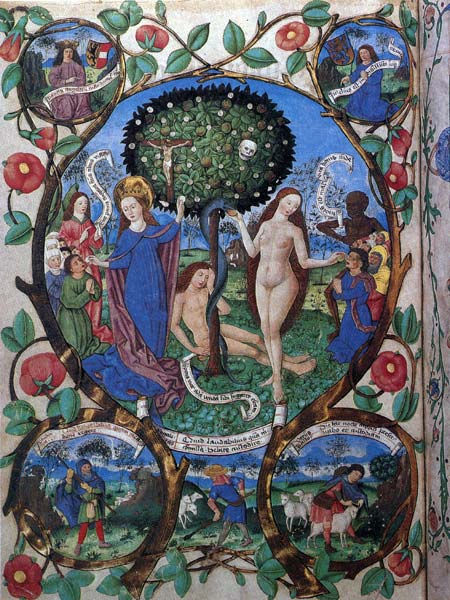
Every act of creativity contains also a destruction - this is portrayed in the medieval manuscript, which gives symbolical description of it. The tree of knowledge rises from Adam’s navel. Adam is looking sleepy, as if he does not entirely comprehend what he has produced. Two women stand beside the tree. The Virgin Mary is on the left, picking fruit from the tree and handing it out to a long line of penitents for their salvation. Eve, stands on the right, picking up the fruit from the same tree, handing it out to a long line of people for their damnation.
Whenever we pluck the fruit of creativity, we also pluck a fruit of destruction.
In Hindu mythology there is Brahma - the creator god, and Shiva - the god of destruction, while Vishnu balances both in the middle.
Heal the Split
Prevailing attitude of today represents sainthood as living as much as possible on the right side, the good side, of the seesaw. Sainthood has been caricatured as an image of the all-right person, the person who has transferred everything to the perfect side of his personality. Such a condition would be completely unstable and would flip immediately - the balance would be disrupted and life would be impossible.
We can hide our dark side from the society, otherwise the social life would not possible, but we must never hide it from ourselves. True sainthood or personal evolution consist of standing in the middle of the seesaw and producing only that which can be counterweighted with its opposites. This is far from the sentimental view of goodness which we set for our ideal.
Marie Louise Von Franz mentions the following stories which attribute to Chuang-tzu:.
The first story is called “Breaking Boxes Open.” It says that in order to protect oneself against boxes being opened that is, jewel cases, trunks of silken clothes, and treasures-putting cords around them and a lot of locks on them is what the world calls intelligent. But if a strong thief comes, he will take the whole box on his shoulder and will hope to goodness that the locks and the cords hold, so that the contents will not spill out. Chuang-tzu then tells of a peaceful country in Tzu where the peasants were very moral and everything was orderly. (Cords and locks stand for morality, for good behavior.) So the land prospered. A robber took possession of that country and was then very insistent that good behavior should continue. Everybody must continue to work and behave properly, and it was now the robber who enforced this because he wanted the country to go on prospering. Neighbors, whether big or small, did not dare criticize or kill him, and for twelve generations the country remained in his and his descendants’ possession. Therefore, as you can see, robbers and thieves are very much interested in good behavior!
Another story goes even further.
Someone asked Chuang-tzu whether robbers have moral attitudes. He said, “Of course, for otherwise they could not be robbers. A robber must know intuitively where the treasures are to be found, and that is his greatness; he must be the first to go in, and that shows his courage; he must know whether a coup is possible, or not, and that is his wisdom; he must afterwards make a just distribution among other gangsters, and that shows his goodness. It is absolutely impossible, therefore, for a robber to be a robber without having great moral qualities. So you can see that as human beings need ethics in order to survive, so do robbers in order that they may be good robbers. Now there are few good and many bad people in the world, therefore obviously morality teachers do not help the world but rather cause damage.
What he really wants to tell is that goodness which requires an artificial effort is not goodness. It can just serve the purpose of the robber, and on other hand, if a robber is a naturally good-natured man, he is not a bad sort of fellow.
We want to define our lives with set of rules to follow - a certain framework in which we can think we would be saved. But one’s evolution and purpose requires a spontaneity and thus awareness of life in every given second. Change is the only constant. We can not create rules to follow in every situation. But we can always act in accordance with our own nature and in accordance to what is right and appropriate in every particular situation. But this subtle, and requires subtlety, presence and connection to oneself and to life.
Chuang-tzu always speaks against teachers of morality, showing their secret destructiveness in estranging man from his natural goodness.
It is better to be true to own nature, when to be artificially ethical or unethical, as Marie-Louze Von Franz says. I will do more damage either way if I am just artificial ( as in the case of Germans and WWII) than I will do if I am just myself , instinctively and healthily. In the latter case I will also do the certain amount of damage, but since every act of creation contains the destruction -the damage would be relatively small, and necessary for my survival.
Nowadays religion is providing men with some set of rules, which completely contradicts to what everyone does in everyday business life. Nothing breaks the person faster than the two sets of contradictory values.
Surprisingly, the middle ground is not the grey point or the space of compromise - it is a realm beyond the space and time and ecstatic dimension of our lives.
Robert A. Johnson points out that we also use the word religion in a wrong way. The word religion stems from the Latin word ligare meaning to bind, bond or bridge. Religion then means to bind together again. It can never be affixed to one side of the pair of opposites.
To think that there is a some kind of religious characteristic is nonsense.
There is only a religious insight that bridges or heals.
William Blake spoke about the need to reconcile these two parts of the self. He said we should go to heaven for form and to hell for energy - and marry the two. When we can face our inner heaven and our inner hell, this is the highest form of creativity.
Mandala
A mandala is generally a symbolic geometric composition of the cosmos. The word comes from Sanskrit meaning “circle” or “center.”
Circle is the most balance geometrical figure which represents wholeness. But also drawing radiating from the center has soothing and healing effect for fractured psyche. All elements emerge and comeback to the same one center, which is symbolically can be named as Tao, Dharma ( or Saturn in Jyotish ), Self in Jungian psychology or simply our essence. We usually unaware of this center, and act attaching to one of the poles of the duality. If we can touch this center, it would be a great leap for balancing our personality and bringing it coherent whole.
Carl Jung in the most disturbing periods of his life gave himself a task drawing a mandala everyday in the notebook, which he carried everywhere with him to keep the sense of balance and proportion.
Mandalas also appear in the dreams when the personality is especially fragmented and the dreamer needs the calming symbol.
Robert A. Johnson points that there is a similar concept, which comes from the Medieval Christianity, but almost forgotten now.

It is called mandorla. Mandela also has a healing effect but its form is somewhat different. A mandorla is that almond-shaped segment that is made when two circles partly overlap. A mandorla is also an Italian word for almond. This symbol signifies the overlap of the opposites, which we have been exploring. Generally, the mandorla is described as the overlap of heaven and earth. We are all torn by the competing demands of the heaven and earth and mandorla begins the healing of the split. This overlap generally is very tiny at first, only a silver of a new moon, but it is the beginning. As time passes, the greater the overlap, the greater and complete is the healing. The mandorla binds together that which torn apart and then two become one.
There are some who lost in matter, preoccupied with things and possessions, they don’t touched by music or anything beautiful - they immersed in matter so much that they lost contact with their soul. Then there are some people are always high - living in the world of fantasies and loosing their touch of the reality.
Human being are in the unique position to unite heaven and earth in themselves - balancing this two forces we can find out how to fulfil our purpose, heal ourselves and others.
We are the Poets
All language is a mandorla. A well-structured natured sentence is of this nature.
A sentence is something like a mathematical equation with the verb representing the equal sign. A correct sentence says that the subject equals the object and annuls the quarrel between the two. The split of the duality is healed.
Given the right container, we can make mandorlas of speech and cure many things - thus becoming poets in our own right in the proper circumstances.
Music is also of the same nature, through tension and release and takes separated elements and binds them together through what we call harmony. Harmony is the flowing balance and proportion.
Poetry has the same nature as music, what musician does with tone, poets does with words, but both have the rhythm.
Hazrat Inayat Khan says like many other that poetry came before language, since it poetic spirit in man who made a language. In Sanskrit language many everyday words rhyme. Mother and father rhyme: matr and patr, also brother and friend: britra and mitra and many others. This shows that for ancient people poetry was everyday language; in other words their everyday language was poetry.
There is a saying that a poet is a prophet, and we know that all great spiritual scriptures: Vedas, Tao Te Ching, Book of Psalms, Quran, Zohar came to us in the form of poetry.
Poetry is born through suffering. Like musician before playing his instrument first needs to tune it, then suffering tunes the heart. Then there is enough suffering the doors of the heart open for poetry. The mission of poetry, like any other art is to inspire and heal. Inspiration is healing in itself, because when we are inspired we raise above the troubles and pettiness of the life.
No doubt that the poet is much more sensitive to the troubles and difficulties of life than anybody else. If he would take everything which came to him into his heart, all the influences which disturb his peace of mind, he would not be able to go on. On the other hand, if he hardened his heart and made it less sensitive, then he would also close his heart to the inspiration that comes as poetry.
So in order to keep his heart open, the one who communicates with life within and without and open to all it’s influences - on the intersection of the two the poetry is born.
Miracle of the Paradox
When see reality as the opposites - the conflict arrises. I want unconditional love, to be loved for what I am, but on other hand I also need to develop my character, virtues and so on - to find the right partner. I also want to be loved by my friends for what I am, but at the same time I want to attract and interact with interesting people, and for that I need to be interesting myself, because people are attracted by my qualities and deeds. Mother’s love is unconditional, father’s love is conditional. So when we start compare and contrast this two - there is a conflict that tears us apart.
To transfer our energy from opposition to paradox is a very large leap in evolution. To transform opposition into paradox is to allow both side of an issue, both pairs of opposites, to exist in equal dignity and worth. If I am able to hold the tension and stay with my conflicting impulses long enough, the two opposing forces will teach each other something and produce the insight that serves them both. That is not compromise but a depth of understanding and certainty of what I should do. It’s tempting to describe the formula, since the solution is unique to every situation and produce by the dynamics of the opposing energies.
This worth of term of enlightenment.
Let us to remember Hindu proverb: “The one who think he is enlightened - certainly not” That means that enlightenment is not the goal or achievement but the process of life itself. Because the world we live is not static, and always changing so as we. We must return to the world of the dualities , of time and space, to continue ordinary life. The shadow is created again and new experience of transformation required.
Marie-Louise von Franz puts it this way:
Jung has said that to be in a situation where there is no way out, or to be in a conflict where there is no solution, is the classical beginning of the process of individuation. It is meant to be a situation without solution: the unconscious wants the hopeless conflict in order to put ego-consciousness up against the wall, so that the man has to realize that whatever he does is wrong, whichever way he decides will be wrong. This is meant to knock out the superiority of the ego, which always acts from the illusion that it has the responsibility of decision. Naturally, if a man says, “Oh well, then I shall just let everything go and make no decision, but just protract and wriggle out of it,” the whole thing is equally wrong, for then naturally nothing happens. But if he is ethical enough to suffer to the core of his personality, then generally...the Self manifests. In religious language you could say that the situation without issue is meant to force the man to rely on an act of God. In psychological language the situation without issue, which the anima arranges with great skill in a man’s life, is meant to drive him into a condition in which he is capable of experiencing the Self.
When thinking of the anima as the soul guide, we are apt to think of Beatrice leading Dante up to Paradise, but we should not forget that he experienced that only after he had gone through Hell. Normally, the anima does not take a man by the hand and lead him right up to Paradise; she puts him first into a hot cauldron where he is nicely roasted for a while.
Think Beyond Space - Time
When we resent , we actuating attaching to one of the poles of the duality, thus impeding the balance.
Balance is the inherent law of the universe. Everything in nature strives for balance. Differences in atmospheric pressure are smoothed out by the wind. Variations in temperature are evened out through heat exchange.
We are so used to this that we hardly ever ask: why must it be so? Why does the law of balance exist at all?
In essence, laws explain nothing - they simply describe what is observed. All natural laws are secondary, derived from the law of balance. This law appears primary (or at least it seems so), which makes it impossible to explain why balance should exist in nature at all.
But as we have seen the balancing forces exist in both internal and external planes - and the only thing what we can is do to respect them or better to say align with them - to live the harmonical life.
So when we are dissatisfied with life - we clinging to the duality.
There is no doubt that gains are good, but what about losses ? But usually we are not aware of all complexity of the situation. Maybe what he have lost is not longer serving us or it is necessary transitionary period to what we aim to become - so it is useless to resent. After loss comes another gain for balance, but clinging to the negativity we are unable to see reality as a whole.
Our ego personality is usually compares with others, but important to understand that all this assessments are relative, even what we call good and evil. In nature everything is neutral, but we give objects, people and ourselves the assessment. But as the center of your universe you and only you can give yourself and your creations a true value.
If someone has something what I want but don’t have - resentment or envy would be a usual ego reaction. But envy has a very particular danger. Usually in this case by projection our shadow - we use to demonise this person and his possessions or creations, and thus unconsciously forbid ourselves to do and have the same.
If we can stop comparing ourselves with other - we can get rid of superiority and inferiority complexes, which require tremendous amount of energy for sustaining themselves. And freeing this energy, we can direct to fulfilling our own purpose, creating our own reality, not caring by our position on the ladder of the social superiority.
What is to think beyond the space and time ?
It is to think in terms of your values.
Why do we come here? Not only waste this precious time, but I do believe to create something meaningful. So when we are able to unite our fragmented personality and focus our energy - we are able to create.
And if we are able in this process not to compare ourselves with others - we are able to create something really unique.
Why some masterpieces, like Dialogues of Plato or Rumi’s Masnavi are still valuable today? Because they were not bothered by the concerns of their present time - but acted through inspiration. Inspiration is the contact with the divine, with your soul - but when rational mind interferes and we start to analyse, access - we are loosing it.
Most likely what is created for the concerns of the present epoch, will be devoured by Time and won’t reach the next generations.
But here lies the paradox - if we create something - we want to be appreciated, recognised here and now, so we create for others and not for our own soul - so it is mercantile, mechanical and will be lost. On other hand, what is the point of the fame after death ? But point is actually not in the fame.
Think of all books that you have read, and which inspired you. Why?
When we would die, most likely, we will reincarnate in the same place , which is here. And we would need to read and expand our consciousness again. So if you, for example, create something - writing a book. You are writing it for yourself, for your future self. This way you can avoid being trapped by the pettiness of the present reality, to prove something, wait for being recognised - but allow your imagination to flow freely.
Then what is the value ?
Value is something timeless as well. Something that you can express you whole life, and most likely in the next life as well.
It is not only about to know your values, but actually expressing them.
We think that “not to give up” means that you don’t give up until you have reached some of your goals, and then you can chill. And so we live in expectation of something. My life would be better If I only can do this, or If only I can have that. This is an illusion, where we create dependency relationships with the object of our desire or goal.
Not to give up - is to act according to one’s values.
To act to be able to express own’s value.
Not to earn money or to become famous, but to be able to have this opportunity to act and move on. So the act itself and this ability to act is the most precious. I don’t know the final destination - this is not important and impossible to predict.
To act
without being carried away
by the dark and bright sides of this path.
— Nikita Ierisov
About me ,
Work with me: Meditation, Jyotish


Comments