
Messages from Within. Anxiety

Updated: Dec 23, 2025
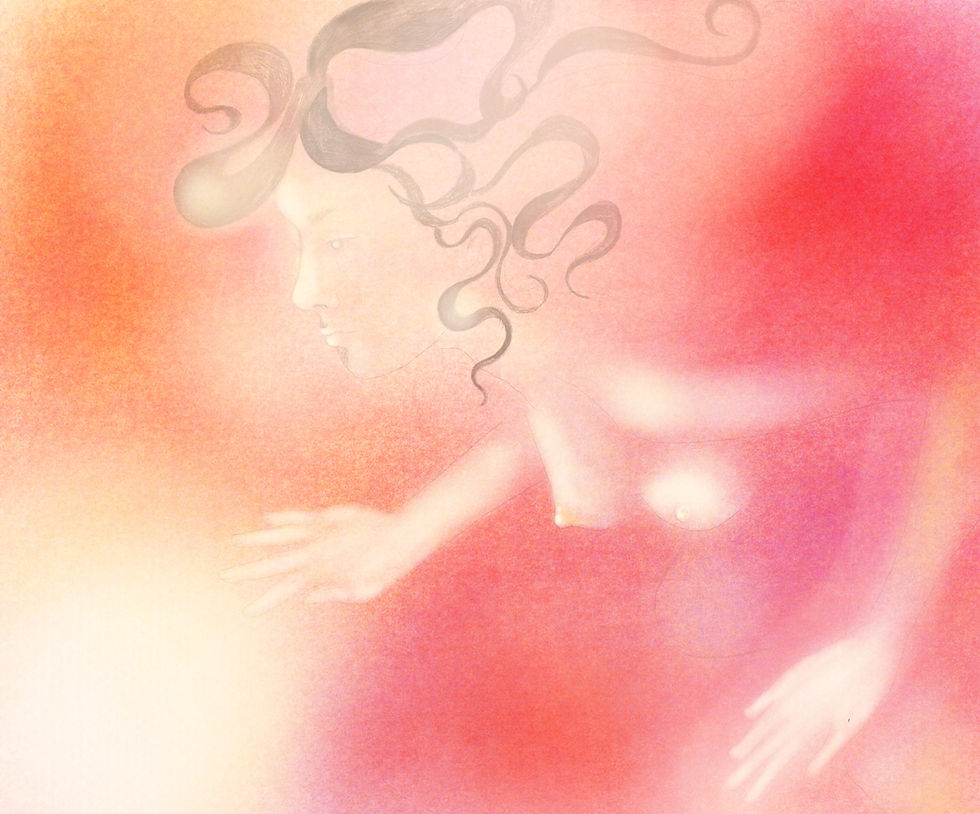
If we pause for just a moment, it becomes clear: anxiety isn’t just mental noise or tension concentrated in the chest or throat. It’s a state that can distort how we see our reality. When we’re anxious, everything feels amplified. Decisions are made from fear instead of truth.
What the internet says… and what’s actually happening inside us?
Most definitions describe anxiety as “a natural reaction to potential danger” — a built-in alarm system that warns us and prepares us for action. That sounds reasonable, but it doesn’t explain the most confusing part:
Why do we feel anxious even when everything around us is fine?
Why does the body react as if there’s danger when nothing seems wrong?
Online advice usually goes like this:
“If your anxiety feels excessive or irrational, talk to a specialist, take calming supplements, vitamins, muscle relaxants…” (If it works for you, then keep doing what you are advised to do)
But there’s one important misunderstanding here: the idea that anxiety can be “irrational” or “without a cause” . It’s a fundamental mistake to say that anxiety can be either rational or ‘without a reason.’
This idea comes from not understanding — or not wanting to acknowledge — that there are deep unconscious forces working inside us.
There is a whole layer of our human structure that our conscious mind simply doesn’t see. Our surface-level, observing mind can’t access it directly.
And this unconscious layer doesn’t just influence our thoughts or emotions — it also affects the body. It shapes our automatic reactions, our physiology, the things we feel even when we don’t understand why.
Human beings don’t feel anything without a reason, the reason lives deeper than our awareness. If anxiety shows up, there is a cause — even if it’s not visible from the outside.
Sometimes the cause is:
• a suppressed impulse to act or create,
• energy that’s stuck and has nowhere to go,
• emotional tension that hasn’t been expressed,
• living in a way that doesn’t match what we truly want,
• exhaustion,
• a creative or physical impulse that’s been ignored for too long.
It looks like psychosomatics begins its journey from this point. Psychosomatics begins in a very simple, very human way. When we stop listening to our inner signals — to our emotions, our anxiety, our quiet “no” and “yes” — the body starts speaking for us. The body becomes the final layer, the last level that can no longer be ignored.
It always begins on a subtle level:
— a bit of anxiety,
— inner tension,
— a sense that something inside is out of alignment, even if we can’t put it into words.
When we constantly suppress these early signals, we stop noticing the soft messages. And then the body has to speak louder.
Many authors — including Louise Hay — tried to describe this in simple language: that many physical symptoms first appear long before any clear organic changes. The finer layers react first: breathing, sleep, muscle tone, hormones. And only later, if the inner conflict persists, the tension can reach the physical layer — the one we finally call illness.
So ignoring anxiety means ignoring the early, gentle messages of the unconscious. It never tries to scare us. It tries to guide us. And when we start listening — breathing, moving, expressing ourselves, truly asking what we need right now — the body becomes an ally again, not the last resort for being heard.
Why “just calm down” doesn’t help? The unconscious trying to reach us.
Because anxiety is a signal from the unconscious, a signal calling for a specific action that we need to become aware of and take. Anxiety is a message from the unconscious layer.
If it comes through the body, it means our conscious mind isn’t able to name or understand it yet.
And the conscious mind blocks this information for many reasons:
• We think the action our deeper self wants is “inappropriate” or “not acceptable” in our family, culture, or environment.
• We believe it’s “not good enough,” “not useful,” or “won’t bring anything practical,” like money or success.
• We’re afraid of being judged, compared, or misunderstood.
• We hold personal prejudices and inner prohibitions we don’t even notice.
So when the conscious mind blocks a natural impulse — the body speaks with anxiety.
Most of the time, this desire lives in the “shadow” — the part of ourselves we avoid or deny.
And we can discover it through indirect signs:
• what we criticize in others,
• whom we envy,
• what irritates us in people.
Because very often, the things we judge in others are things we secretly want for ourselves but don’t allow.
And our job here is to ask:
What am I forbidding myself?
What do I deeply want but don’t dare to admit?
Which beliefs are holding me back?
When someone is anxious, they start searching for answers. Reading a list of symptoms usually makes things worse, because it plants the idea that something is “wrong” or “dangerous” with them.
And most common suggestions focus on suppressing the anxiety — not understanding it. That’s like turning off a fire alarm without checking why it started ringing. The pressure inside doesn’t disappear. It just sinks deeper into the body — into muscle tension, exhaustion, and a feeling of inner tightness.
Energy looking for a way out
I found a very helpful way to look at anxiety for myself. It can also be a sign that all layers of my body wants Freedom and Expression.
It may be telling me: dance, sing, move, play, create, change something in your routine, express what you’ve been holding back.
This energy wants to move; it wants to do things in its own way. Every person has natural impulses — to throw, to paint, to jump, to walk barefoot, to say what they feel. When we suppress these impulses, the energy has nowhere to go. It builds up inside, and that pressure is what we call anxiety. The more we block our own aliveness, the harder we become to live with — first for ourselves, and then for everyone around us. It really is true — living next to an anxious person can feel unbearable. And it’s not because your partner or your neighbor is impatient, or because they don’t love you. It’s their unconscious defense mechanism. Anxiety is contagious. You can catch it just by being around it. We’re social beings. And when someone around us is anxious, our own system responds. We’re wired for empathy, wired to pick up the emotional signals of the people near us. That’s why it can feel like we ‘catch’ someone’s anxiety — it’s literally a social function built into us. And this is important to understand if you’re the one who lives with anxiety: when people step back or need space, they’re not rejecting you. They’re simply reacting to the emotional signal your nervous system is sending out.
It’s not about love, kindness, or patience — it’s biology.
So don’t take distance as an offense. Don’t think, “I’m anxious, and you’re avoiding me — you must not care.” Most of the time, the other person is just trying to regulate their own system, the same way you’re trying to regulate yours.
And yes — sometimes we hide behind labels like “I’m just too sensitive,” or “I react strongly because I feel everything deeper.”
Sensitivity is a beautiful tool — with it we can create incredible things.
But when we suppress the desire and the impulse to create those beautiful things, that same sensitivity can turn against us. It can make communication sharp, tense, or overwhelming for others. Not because you’re a bad person,
but because your system is overflowing with energy that hasn’t found its direction yet.
Understanding this is empowering.
It means you’re not broken — you’re simply carrying more emotional charge than your conscious mind knows how to process.
And when you learn to work with that energy — to move it, to express it, to ground it — relationships around you naturally soften too.
I deeply believe learning to listen to your inner voice, to release that energy—it’s not just personal work, it builds a productive reality around. It’s a contribution to collective health. It supports your family, your friends, your community, and honestly, the whole world.
In that sense, anxiety is a Compass, pointing toward the parts of life that want to open, move, or change.

The path out of anxiety isn’t a dramatic leap — it’s a soft, steady series of small steps. Steps that bring your inner world back into balance and help you feel alive, real and whole.
Everyone has their own way.
Anxiety isn’t a malfunction that you fix with one universal instruction.
There isn’t one magic exercise for everyone. The real answer is always personal. And It comes from intuition, from sensing yourself, trying new, with letting new experiences into your life, or, on the contrary, remembering what you liked as a child, from paying gentle attention to what’s alive inside you.
Practices that help you hear what your body wants
To understand where this energy wants to go, you don’t need force or pressure — you need space. A moment to feel yourself again.
Gentle practices help bring the mind back into the body:
Hatha Yoga,
Pranayama,
Meditation,
Dancing or simple rhythmic movement,
Vocal warm-ups,
Any creative activity that brings you back to life.
These practices don’t “fix” anxiety — they help you hear yourself more clearly.
Therefore, you don’t have to wait for it to go away on its own; you need to take some kind of activity and set yourself the goal of hearing the answer.
And when you hear yourself, it becomes obvious where your energy actually wants to move. When that energy flows, anxiety naturally softens.
Paradoxically, to move out of anxiety, we don’t need to speed up. We need to slow down. Pause. Breathe.
Breath is the simplest way to come back “home.”
Pranayama, meditation, soft awareness of the body, sound practices like singing bowls — none of these are mystical. They’re ways to return to reality instead of staying inside an anxious imagination. These are very powerful instruments, especially when we set ourselves the goal of working with them and learning (like with a singing bowl). It teaches us to sing and hit notes. Toning practice with a bowl is especially effective.

In these moments, clarity arrives:
• What am I truly feeling right now?
• What do I actually want?
• Which impulse have I been suppressing?
When we give ourselves permission to hear these answers, life naturally expands. New activities appear. New movements of energy. New forms of creativity. And slowly, anxiety no longer needs to bang on the door from inside.
In truth, anxiety is a gift. We can treat it like a compass—something that quietly tells us: ‘Hey, it’s time to pause, turn around, or ask yourself what you truly need right now. When we listen to anxiety this way, it stops being an enemy and becomes guidance. A gentle reminder to return to ourselves.
— Sasha Podgurska
Dharma Station,
Vancouver Island, Canada


Comments