
Sacred Geometry

Updated: Nov 23, 2025
Have you ever thought why the forms in nature attract us so much ?
The idea is threaded through all Vedic texts, that: "The Universe is The Ocean of Vibration"
From this ocean, every form arises as a wave made visible.
And as vibration condenses into matter, it expresses itself through patterns of harmony.
Every form in nature follows the same harmonical proportions that we find in music.
All music follows "whole number proportions" of the overtone scale, the so-called "harmonics".
Harmonics

As demonstrated by Pythagoras few millennia ago with his experiment on lyre or monochord. We can find this harmonics by dividing string of monochord by twelve equal parts.
Let's say we have monochord we string C and shorten it by half, then the sound will be a
higher C' or we can call this interval an octave (1:2). If we shorten it by 8 points then interval will be 12:8 ( 2:3 ) or so called "perfect fifth". If we shorten string by 9 points - 12:9 (4:3).
And so forth.
One basic rule is immediate from this: The lower the proportions of the numbers, the stronger the consonance, the more "harmonious" the sound of the two tones together.
In fact, the most frequent consonance by far is also the most "harmonious" - the octave, the proportion 1:2, which has always been used to signify the polarity of the world: yang and yin, male and female, heaven and earth - polarity "written in the sky"
But it is also "written in our ears". Our ears prefer consonance, major proportions, low-number relations. This is true for the ears of human beings of all races and nations as well as for the ears of birds as well as apes, dogs, whales, dolphins, wolves and other animals.
Form is the Frozen Music
Vedic teachings say that everything in Universe including ourselves consist of vibration.

Science of harmonics shows that any form of organic life - fish, flower, a leaf, a beetle, any creature - is sound, and even the most 'beautiful' form of the inorganic world, the crystals - are sound as well, meaning that their structure is dominated by numbers which can form consonances. Many things which we find to be "beautiful" in nature, art and the human body follow the laws of the golden section. The proportions of golden section vacillate around the musical intervals of major (3:5) and minor (5:8) sixths and and around so-called ecmelic intervals (8:13, 13:21 etc. ), which can be interpreted as variations of the sixths.
Hans Kayser (1891–1964) was a Swiss musician, mathematician, philosopher, and one of the last great “Pythagoreans” of the 20th century. He devoted his entire life to understanding harmonics.
Kayser revived the ancient Pythagorean idea that the universe is built according to harmonic ratios.But he used modern physics, crystallography, mathematics, and acoustics to support it. His major work, Akroasis: The Theory of World Harmonics, is considered one of the most profound books on the subject.
Hans Kayser suggested that a crystal is like frozen music:
The angles, axes, and faces of a crystal are built on whole-number ratios, the same kind of ratios that form the harmonic series in sound. When these geometric proportions are translated into notes, the crystal’s structure becomes a chord or scale. Just as every musical instrument has its own tuning, each crystal has a “key” or fundamental tone, defined by the numerical proportions in its inner lattice. By studying its geometric ratios, we can “hear” its form through musical translation.
Kayser who studied rock crystals in the mountains of Switzerland writes:
"Anyone, who plays these sample notations on an instrument will hear how individual - in fact, how "modern" - the surface scaling of each of the various crystal is. Often utterly magnificent sequences of notes are the result. Who knows what surprises we might encounter if we would take the trouble to notate all these themes and chords. We would certainly have a collection of musical structures ranging from the simplest and most monumental to the most differentiated and interesting, and inexhaustible source of themes for counterpoint and polyphony."
Where crystals grow outward through fixed, repetitive ratios, leaves and flowers unfold dynamically, like music in motion. Their veins, spirals, and symmetries are built upon the same whole-number proportions that define harmonic intervals. Kayser believed that plants represent a higher harmony compared to minerals.
The same mathematical laws that lock a crystal into a perfect cube or hexagon come alive and spiral in a leaf, producing the organic forms we associate with growth.
Why Plants Use Fibonacci? - Maximum Sunlight
Plants do not place their leaves randomly.They follow a mathematical law of growth known as phyllotaxis, and this law is deeply connected to: The Fibonacci sequence: 1, 1, 2, 3, 5, 8, 13, 21… This sequence generates the golden ratio (φ = 1.618...), a harmonic proportion also found in music.
These are not abstract numbers - they are nature’s code for efficient growth.
A plant must avoid placing its leaves directly above each other. If leaves stack vertically, the plant shades itself - reducing photosynthesis.
To solve this, nature “invented” the most efficient angle of rotation:
137.5° - the Golden Angle

This angle is derived from the Golden Ratio.
It is the angle at which each new leaf is placed so that it never hides the one below it. Over time, this creates a perfect spiral around the stem. This angle optimizes: sunlight exposure, rain distribution and inner space for growth.
It is the most efficient packing ratio possible.
"The sound is the source of all manifestation... The knower of the mystery of sound knows the mystery of the whole universe" - Sufi Master Hazrat Inayat Khan says.
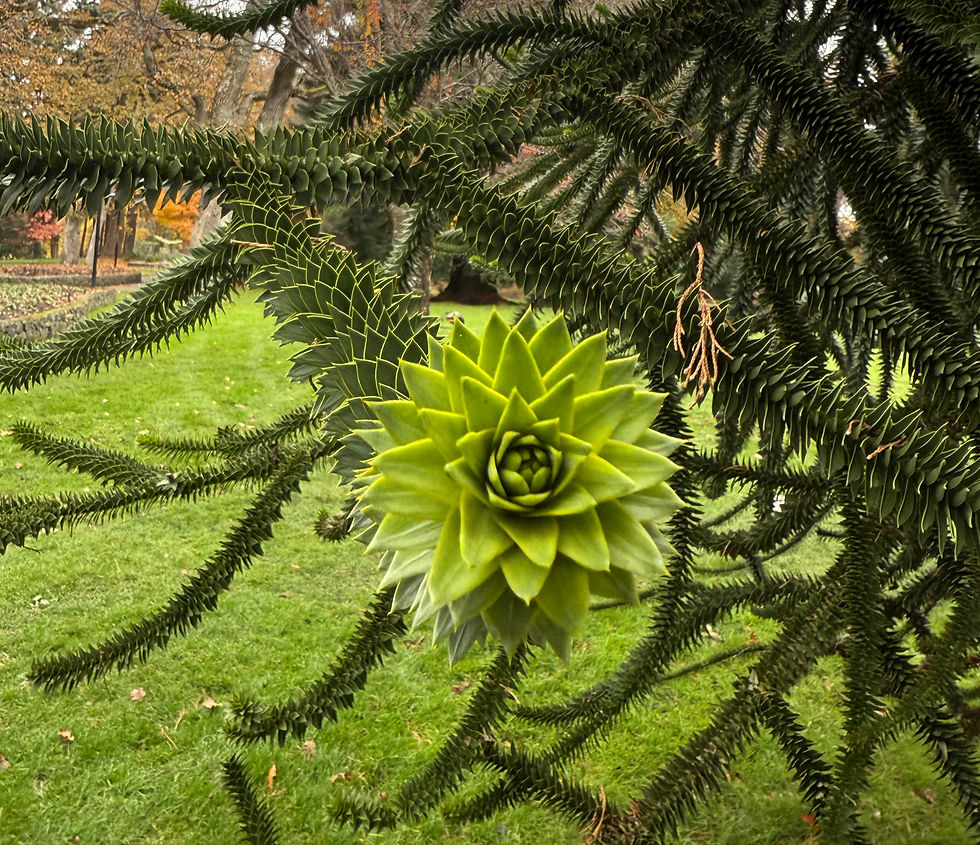
Monkey Puzzle Tree - A Living Fossil in British Columbia.
The tree on the picture is called Monkey Puzzle Tree or Araucaria araucana, which I found in Beacon Park in Victoria, BC.
It predates flowering plants, it predates birds, it predates the Andes Mountains, and evolved during the Jurassic period, when long-necked dinosaurs fed on its branches.
It is fascinating because the tree is over 200 million years old as a species, it is literally a dinosaur-era tree still growing today. It has very distinctive appearance with spiral, geometric leaves and “dragon tail” branches.
This tree is native to Native to: Chile (Araucanía region) and Argentina (Patagonia) especially in high volcanic slopes of the Andes. These forests are sacred to the Mapuche people, who call the tree: Pehuén and consider it a spiritual ancestor.
Many trees live 1,000+ years, some are estimated to be 2,000 years old. However, they are endangered (IUCN Red List) to extinction with main threat of: logging and climate change. They also have extremely slow regeneration.
When we study these patterns in nature, we begin to see them everywhere: in human body proportions, leaves, trees, DNA, and even in the trajectories of planetary motion. Music works directly with the laws of harmony; yet it is not that everything in the universe follows the laws of music. Rather, harmony is an intrinsic characteristic of being itself - a code woven through all manifested forms of nature.
In the next blogpost I will describe , how the same principles of harmonics are manifested in human architecture.
Stay tuned!
(c) Nikita Ierisov
Philosopher
Keeper of Dharma Station,
Vancouver Island, Canada
Comments